


You did everything right. You went for the consultation, completed the tests, and the doctor said everything looks normal. You expected relief, but months passed and there is still no pregnancy. Now you may be wondering what is going wrong, and why “normal” reports have not given you a baby.
If you are dealing with normal fertility tests but not being pregnant, you are not alone, and it does not mean you did something wrong. This guide explains what is happening and what your options usually are.
What Does “Normal Fertility Tests” Really Mean?
Standard fertility tests check the most common and measurable causes. These usually include ovulation, ovarian reserve, the uterus and tubes on scan or imaging, and semen analysis. A normal result means these checks did not show a clear problem.
It does not mean everything about fertility has been tested. Conception depends on many steps working together, such as egg quality, egg release, sperm reaching and fertilising the egg, the embryo travelling to the uterus and implanting in the lining. Routine tests cannot assess every one of these steps.
What Is Unexplained Infertility?
When both partners’ basic tests are normal and pregnancy still does not happen, doctors call it unexplained infertility. It is more common than most couples think, and it is a recognised diagnosis, not a dismissal of your concern.
It simply means the usual tests have not found a specific reason. Many couples with this diagnosis do go on to conceive, with or without treatment, though outcomes vary and cannot be promised.
Why Can Pregnancy Not Happen Despite Normal Reports?
Doctors do not always find a single cause, but some possibilities include:
- Subtle egg quality issues: Egg quality cannot be measured directly by routine tests, and it reduces gradually with age.
- Fertilisation or implantation problems: These steps happen inside the body and cannot be seen on standard tests.
- Mild or early endometriosis: Small patches may not appear on ultrasound. Our guide on endometriosis, cysts and adhesions explains this further.
- Thin adhesions or minor tubal problems: These are often missed on scans.
- Small changes inside the uterus: Such as tiny polyps or a thin septum, which may not show clearly on a standard scan.
- Sperm function: A normal count does not always reflect how well sperm function or bind to the egg.
- Timing: Intercourse may not be falling in the fertile window, even in women with regular cycles.
- Lifestyle factors: Weight, stress, sleep, smoking and alcohol can affect fertility in both partners.
Sometimes more than one small factor is involved, and each one on its own is too minor to appear on a test.
Are You Timing Intercourse Correctly?
This is a simple but often overlooked point. The fertile window is roughly the five days before ovulation and the day of ovulation itself. For many women with a regular 28 to 30 day cycle, this falls in the middle of the cycle, but it varies.
Helpful ways to find it include:
- Tracking cycle dates over a few months
- Noticing cervical mucus changes, which become clear and stretchy near ovulation
- Using ovulation predictor kits
- Asking your doctor about ovulation tracking by scan
Intercourse every one to two days during the fertile window is generally advised, without making it feel like a chore.
Step 1: Review the Tests Already Done
First, your doctor will go through your reports again with you. Sometimes a test needs to be repeated, was done at the wrong time in the cycle, or needs a closer look. A detailed visit for general gynecology and a repeat infertility evaluation can help decide whether anything has been missed.
Step 2: Consider Further Tests
If basic tests are normal, further checks may be suggested depending on your age, history and how long you have been trying. These may include:
- Repeat or focused pelvic scans timed to your cycle
- Additional hormone tests
- Tests for the uterine cavity
- Further assessment of sperm if there is a concern
Not every couple needs all of these. Your doctor will suggest only what is relevant.
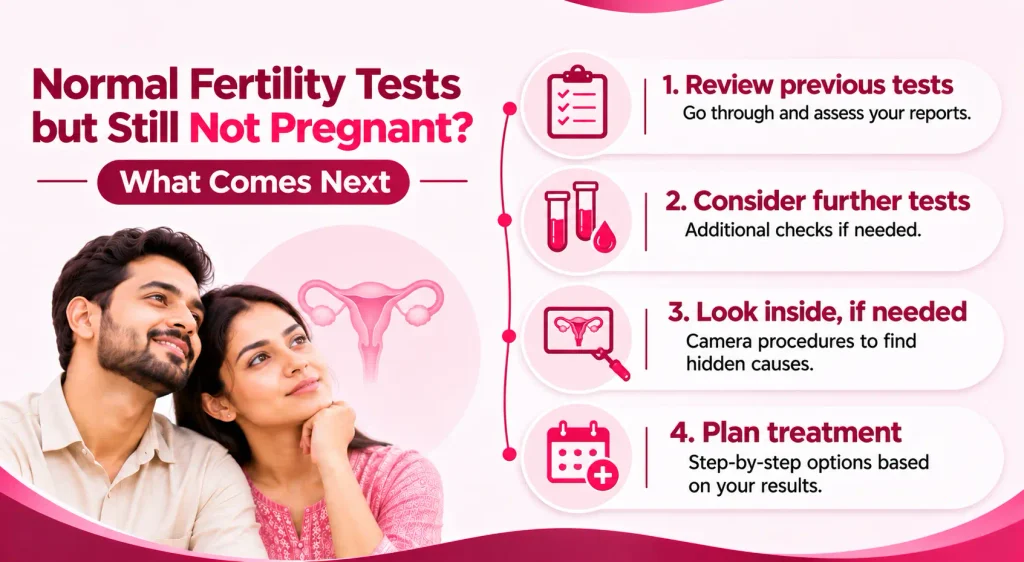
Step 3: When Looking Inside Directly May Help
When symptoms such as painful periods, pelvic pain or pain during intercourse are present, or when tests are unclear, a camera procedure may be considered.
- Hysteroscopy services allow the doctor to check the inside of the uterus for polyps, adhesions or a septum.
- A diagnostic laparoscopy helps examine the tubes, ovaries and pelvis for endometriosis or adhesions that scans may miss.
- If a treatable problem is found, it may be addressed in the same sitting through operative laparoscopy, provided it has been discussed and consented to beforehand.
These are not needed for everyone. They are usually suggested only when there is a reason to suspect a hidden problem. You can read about all of them under the clinic’s laparoscopy services.
Step 4: Treatment Options for Unexplained Infertility
Treatment for unexplained infertility is usually step by step, starting with the least invasive options. Depending on your age and how long you have been trying, your doctor may suggest:
- Lifestyle and timing guidance: Healthy weight, balanced nutrition, regular sleep, avoiding smoking and alcohol, and well-timed intercourse
- Ovulation support: Medicines that help the body release one or more eggs in a planned way, such as ovulation induction
- Treatment of any small problem found: For example, fibroid and cyst management if relevant
- Further options: If earlier steps do not work, advanced infertility support may be discussed
The right choice depends on your age, how long you have been trying, test results and your preferences. No treatment can be guaranteed to work, and your doctor will talk through realistic expectations.
How Long Should You Wait Before Moving to the Next Step?
There is no fixed rule, but age matters a lot. If you are under 35, doctors often suggest trying simpler steps for several cycles before reviewing. If you are 35 or older, the review usually happens sooner, because egg quality and quantity reduce with age. Ask your doctor to agree on a clear timeline with you, such as “try this for three to six cycles, then review.”
What You Can Do Meanwhile
- Maintain a healthy weight through balanced food and regular movement
- Avoid smoking, tobacco and excess alcohol, and limit caffeine
- Take folic acid as advised by your doctor
- Manage stress through sleep, walks, hobbies or counselling
- Keep regular medical check-ups and preventive care
- Do not rely on unproven supplements or home remedies without medical advice
Coping With the Emotional Side
Waiting month after month with no explanation is exhausting. It is normal to feel anxious, sad or frustrated, and to avoid social events where pregnancy comes up. Some things that help:
- Talk openly with your partner about how you each feel
- Avoid blaming yourself or each other
- Take breaks from tracking and testing when you need them
- Limit comparing your journey with others
- Consider counselling if stress feels heavy
Warning Signs That Need Prompt Attention
See a doctor sooner if you have:
- Very painful or increasingly painful periods
- Heavy bleeding or bleeding between periods
- Pain during intercourse
- Fever with lower abdominal pain
- Sudden severe pelvic pain
- Pain along with a missed period
Final Thoughts
Normal reports can feel confusing when the pregnancy test keeps coming back negative. But “normal” does not mean “hopeless.” It means the common causes have been ruled out, and the next step is a careful review, a sensible plan and, when needed, a closer look.
If you have been trying to conceive with normal test results and want a clear plan, you can learn more about Dr. Swarnima Das and her approach to women’s health, or contact us to book a consultation. You can also read more helpful articles on the clinic blog.
Disclaimer: This article is for general awareness only and is not a substitute for professional medical advice, diagnosis or treatment. The cause of infertility and the right treatment can only be decided by a qualified doctor after a proper evaluation. Results vary from person to person, and no outcome is guaranteed.
Frequently Asked Questions
Can you have normal fertility tests and still not get pregnant?
Yes. Standard tests check the most common causes, but they cannot assess every step of conception, such as egg quality, fertilisation or implantation. When all basic tests are normal, doctors call it unexplained infertility, which is common and does not mean treatment will not work.
What is unexplained infertility, and how common is it?
It is a diagnosis given when the usual tests in both partners show no clear cause. It accounts for a notable share of couples seeking help. It does not mean your concern is being dismissed, and there are treatment options your doctor can discuss. An infertility evaluation is the first step in reaching this diagnosis.
Can endometriosis or adhesions be missed on fertility tests?
Yes. Early endometriosis and thin adhesions often do not show on ultrasound. If you have pain or other symptoms, your doctor may suggest a diagnostic laparoscopy to look directly, but only after a proper evaluation.
How long should we try before starting treatment for unexplained infertility?
It depends on your age and how long you have been trying. Younger couples may try simpler steps for several months first, while those 35 or older are usually advised to move forward sooner. Your doctor will help set a clear timeline.
Will we need IVF if all tests are normal?
Not necessarily. Many couples begin with lifestyle changes, timed intercourse or ovulation induction. Advanced options are considered only if earlier steps do not work, and every step is discussed with you first.